Diamond 4Cs charts, often available as PDF guides, are essential tools for buyers. They detail cut, color, clarity, and carat, aiding informed decisions.
What are the 4 Cs?
The 4 Cs – Cut, Color, Clarity, and Carat – represent the globally recognized standard for assessing diamond quality. A comprehensive 4Cs chart PDF visually breaks down each characteristic, offering a clear understanding for consumers. Cut refers to how well a diamond’s facets interact with light, impacting brilliance. Color grades diamond whiteness, with D being colorless. Clarity assesses inclusions and blemishes, ranging from flawless to included. Finally, Carat measures diamond weight, directly influencing price. Utilizing a PDF chart simplifies navigating these complex factors, empowering buyers to make informed choices.
Why are the 4 Cs Important?
Understanding the 4 Cs is paramount when purchasing a diamond, ensuring you receive value for your investment. A detailed 4Cs chart PDF provides a standardized framework for comparison, preventing misleading sales tactics. Each ‘C’ significantly impacts a diamond’s beauty and price. Ignoring even one can lead to dissatisfaction. These guidelines, readily available in PDF format, empower buyers to assess quality objectively; They facilitate informed decisions, guaranteeing a diamond aligns with both preferences and budget. Utilizing these charts ensures a confident and satisfying purchase experience.
Cut: The Brilliance Factor
Cut profoundly affects sparkle; 4Cs chart PDFs illustrate ideal proportions for maximum brilliance, detailing grades from Ideal to Poor for informed selection.
Cut Grades Explained (Ideal, Very Good, Good, Fair, Poor)
Diamond cut grades, comprehensively detailed in 4Cs chart PDFs, categorize brilliance. Ideal cuts maximize light return, exhibiting exceptional sparkle. Very Good offers excellent brilliance, slightly less than Ideal. Good cuts provide decent sparkle, while Fair and Poor demonstrate diminished brilliance due to light leakage.
These charts visually demonstrate how proportions—depth, table, and girdle—influence light performance. Understanding these grades, as presented in the PDFs, empowers buyers to select a diamond with optimal brilliance and fire, aligning with their preferences and budget. Careful review of these charts is crucial.
Impact of Cut on Diamond Sparkle
Diamond cut profoundly impacts sparkle, as illustrated in detailed 4Cs chart PDFs. A well-cut diamond maximizes light reflection, creating brilliance, fire, and scintillation. Poorly cut stones leak light, appearing dull. Charts visually demonstrate how precise angles and proportions are vital.
These PDF resources showcase how depth, table, and crown angles affect light performance. Understanding these elements, as presented in the charts, allows buyers to assess a diamond’s potential for sparkle. Choosing a diamond with an ‘Excellent’ or ‘Very Good’ cut grade, guided by these charts, ensures maximum brilliance.
Cut Proportions and Their Influence
4Cs chart PDFs meticulously detail crucial cut proportions – depth, table, crown angle, and pavilion angle – and their influence on a diamond’s appearance. These charts visually explain how deviations from ideal ranges impact brilliance and fire.
A diamond’s depth percentage, for example, affects how light reflects internally. Similarly, table percentage influences the size of the top facet. PDF guides demonstrate how these proportions work together. Understanding these details, as presented in the charts, empowers buyers to select a diamond optimized for maximum light return and sparkle, avoiding light leakage.

Color: Assessing Diamond Whiteness
4Cs chart PDFs illustrate the diamond color scale (D-Z), visually demonstrating how subtle differences in color affect value and appearance.
The Diamond Color Scale (D-Z)
Diamond color charts, frequently found as PDF resources, meticulously detail the grading system ranging from D (colorless) to Z (light yellow or brown). These 4Cs chart PDFs visually represent each grade, allowing buyers to understand the nuances. D-F grades are considered colorless and command premium prices. G-J are near-colorless, offering excellent value.
As you move down the scale towards K-Z, color becomes more noticeable. PDF guides often include images showcasing the subtle differences. Understanding this scale, as presented in these charts, is crucial for selecting a diamond that meets both aesthetic preferences and budgetary constraints.
Near Colorless vs. Light Color
4Cs chart PDFs effectively illustrate the difference between near-colorless (G-J) and light color (K-Z) diamonds. Near-colorless stones appear white to the naked eye and offer excellent value, often indistinguishable from colorless diamonds when mounted. These PDF guides frequently include comparative images.
Light color diamonds exhibit a noticeable tint, impacting their price. However, they can be a budget-friendly option, particularly for settings that mask color. Detailed diamond color charts within these PDFs help visualize these subtle variations, empowering informed purchasing decisions based on personal preference and budget.
Fancy Colored Diamonds
While standard 4Cs chart PDFs primarily focus on colorless diamonds, they often acknowledge fancy colored diamonds as an exception. These vibrant stones—like pink, blue, or yellow—are graded using different criteria, prioritizing hue, saturation, and tone over traditional colorlessness.
PDF guides dedicated to fancy colors detail unique grading scales. The intensity of color significantly impacts value; vivid hues command premium prices. Though the 4Cs still apply (cut influences brilliance), color is paramount. Charts illustrate color variations, aiding identification and appreciation of these rare and captivating gems.

Clarity: Identifying Inclusions and Blemishes
4Cs chart PDFs visually demonstrate clarity grades (FL-I3), showcasing examples of inclusions and blemishes affecting a diamond’s internal and external flaws.
The Diamond Clarity Scale (FL-I3)
Diamond clarity charts, frequently found as PDF resources, illustrate the GIA’s grading system ranging from Flawless (FL) to Included (I3). These PDFs detail each grade, explaining the type and size of inclusions visible under magnification. FL diamonds possess no internal flaws or blemishes, while I3 stones exhibit significant inclusions impacting brilliance.
VVS1 & VVS2 show very slight inclusions, difficult to see even for trained graders. VS1 & VS2 have minor inclusions. SI1 & SI2 show noticeable inclusions, and I1 & I2 have obvious inclusions. Understanding this scale, as presented in a 4Cs chart PDF, is vital for assessing a diamond’s value and appearance.
Types of Inclusions
Diamond clarity charts, often available as comprehensive PDF guides, detail various inclusion types. Common inclusions include crystals (internal mineral deposits), feathers (fractures), and clouds (grouped pinpoint inclusions). PDF resources visually demonstrate these, aiding identification. Other types are needles, pinpoints, and surface blemishes like polish lines or extra facets.
The size, number, position, and nature of inclusions impact a diamond’s clarity grade. A 4Cs chart PDF helps visualize how these factors affect appearance and value. Understanding inclusion types, as shown in these guides, empowers informed purchasing decisions.
Impact of Clarity on Value
A diamond clarity chart PDF clearly illustrates the correlation between clarity and price. Diamonds with fewer inclusions are rarer and, therefore, more valuable. Flawless (FL) and Internally Flawless (IF) diamonds command the highest premiums. As inclusions increase – from VVS to SI and I – value decreases.
PDF guides demonstrate how even slight clarity differences significantly impact cost. While inclusions don’t always affect beauty, they do influence a diamond’s grade and market value. Understanding this, via a 4Cs chart PDF, is crucial for budget-conscious buyers.
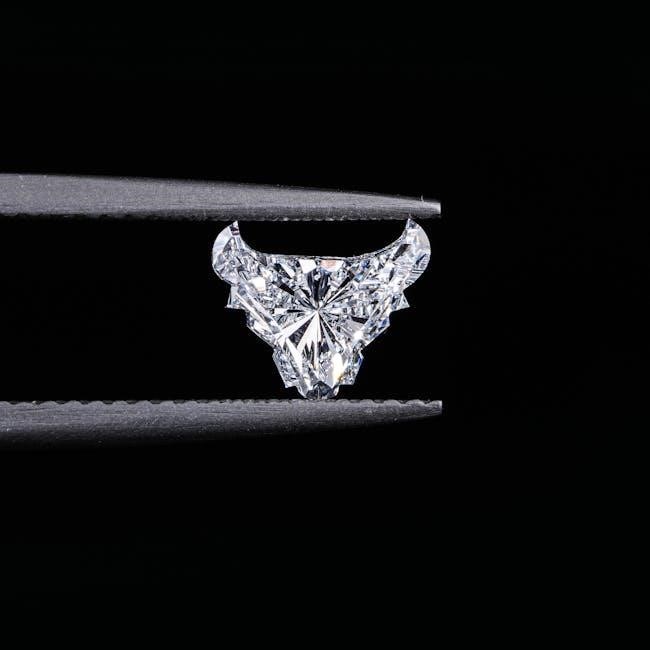
Carat: Measuring Diamond Weight
Carat, detailed in a 4Cs chart PDF, measures weight, not size. Larger carats are rarer, increasing value; PDFs help understand weight-to-size ratios.
Understanding Carat Weight and Size
Many assume a larger millimeter measurement directly correlates to a higher carat weight, but this isn’t always true. A 4Cs chart PDF clearly illustrates how different cuts impact the visual size for a given carat weight. For example, a well-cut diamond can appear larger than a poorly cut one of the same carat size.
Carat refers specifically to the diamond’s weight – one carat equals 0.2 grams. PDF guides often include charts showing approximate millimeter sizes for various carat weights and cuts, helping buyers visualize the difference. Understanding this distinction, aided by a comprehensive 4Cs chart PDF, is crucial for making an informed purchase.
Carat vs. Size: A Common Misconception
A frequent misunderstanding is equating carat weight with a diamond’s physical size; A 4Cs chart PDF effectively demonstrates that two diamonds with identical carat weights can appear vastly different in size, depending on their cut. A shallower cut will spread the weight over a larger surface area, creating a bigger-looking diamond.
Conversely, a deeper cut concentrates the weight, resulting in a smaller appearance. These PDF resources visually highlight this, showing millimeter measurements alongside carat weights for various cuts. Utilizing a 4Cs chart PDF helps buyers prioritize value and appearance beyond simply focusing on carat weight.
Carat Weight and Price Relationship
Generally, a diamond’s price increases exponentially with carat weight, as larger diamonds are rarer. A comprehensive 4Cs chart PDF illustrates this price jump, showcasing how costs escalate at key weight milestones (e.g., 1.0ct, 1.5ct, 2.0ct). However, the PDF also emphasizes that carat isn’t the sole price determinant.
Cut, color, and clarity significantly influence value. A smaller, exceptionally well-cut and colorless diamond can command a higher price than a larger stone with lower grades. Examining a 4Cs chart PDF alongside price guides provides a realistic expectation of costs based on combined quality factors.
Diamond Measurement Charts & Tools
Diamond gauge tools and 4Cs chart PDFs help estimate carat weight and size, crucial for assessing value and comparing stones effectively.
Diamond Gauge Tools for Carat Estimation
Diamond gauge tools are incredibly useful for quickly estimating the carat size of a mounted diamond, eliminating the need for precise measurements initially. Many are conveniently card-sized and portable, making them ideal for use during viewings or appraisals. These tools often correlate diameter or width with approximate carat weights, assisting in preliminary assessments.
Complementing these tools, a comprehensive 4Cs chart PDF provides a detailed reference for understanding how carat weight relates to other factors like cut and shape. Utilizing both resources empowers buyers to make informed decisions, especially when evaluating multiple stones and comparing their value propositions. Accurate estimation is key!
Using a 4Cs Chart PDF
A 4Cs chart PDF serves as a foundational resource for anyone navigating the diamond market. These charts visually represent the grading scales for cut, color, clarity, and carat, offering a clear understanding of each characteristic. They often include diagrams illustrating inclusion types and color gradations, aiding in visual assessment.
Effective use involves cross-referencing the diamond’s certificate with the chart, verifying the assigned grades. A good PDF will also explain how each ‘C’ impacts value and appearance, empowering informed purchasing decisions. Downloadable guides enhance your knowledge and confidence.
Standard Diamond Sizes (1.0mm ー 15mm)
Diamond size charts, frequently found within 4Cs chart PDFs, detail diameter or width measurements ranging from 1.0mm to 15mm. These charts correlate size with approximate carat weight, though weight varies by cut. Understanding this relationship is crucial; a larger millimeter measurement doesn’t always equate to a higher carat weight.
These charts are invaluable for estimating carat weight when only diameter is known, particularly for mounted stones. Remember that different cuts (round, princess, etc.) will have varying millimeter-to-carat ratios. Utilize these charts alongside certificate information for accurate assessment.
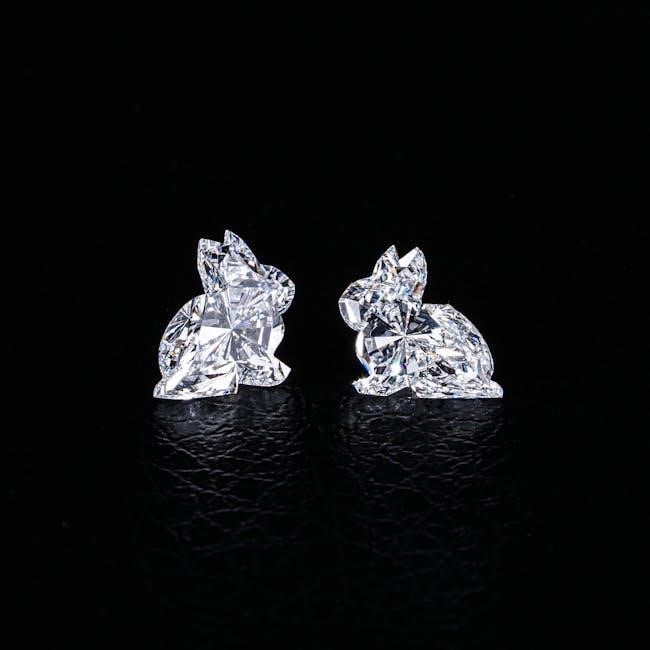
Diamond Anatomy & Terminology
4Cs chart PDFs often include diagrams illustrating key anatomy: table, crown, pavilion, and girdle. Understanding these terms aids in assessing a diamond’s cut quality.
Table, Crown, Pavilion, and Girdle
Diamond 4Cs chart PDFs frequently detail anatomical components crucial for evaluating cut quality. The table is the large, flat facet on top, while the crown encompasses facets above the girdle. Below the girdle lies the pavilion, comprising facets leading to the culet. The girdle is the narrow band separating the crown and pavilion.
These charts often visually represent these parts, explaining how their proportions impact brilliance, fire, and scintillation. Understanding these terms, as presented in a PDF guide, empowers buyers to assess a diamond’s overall cut and light performance, directly influencing its value and aesthetic appeal.
Depth and Table Percentage
Diamond 4Cs chart PDFs consistently highlight depth percentage and table percentage as vital cut parameters. Depth percentage—total depth divided by width—impacts light return. Ideal ranges typically fall between 59-62.5%. Table percentage, the table’s diameter relative to the diamond’s width, ideally should be between 53-64%.
These measurements, clearly outlined in a PDF, influence brilliance and fire. Charts often illustrate optimal proportions, demonstrating how deviations affect light performance. Understanding these percentages allows buyers to assess a diamond’s cut quality beyond just the overall grade, ensuring maximum sparkle and value.
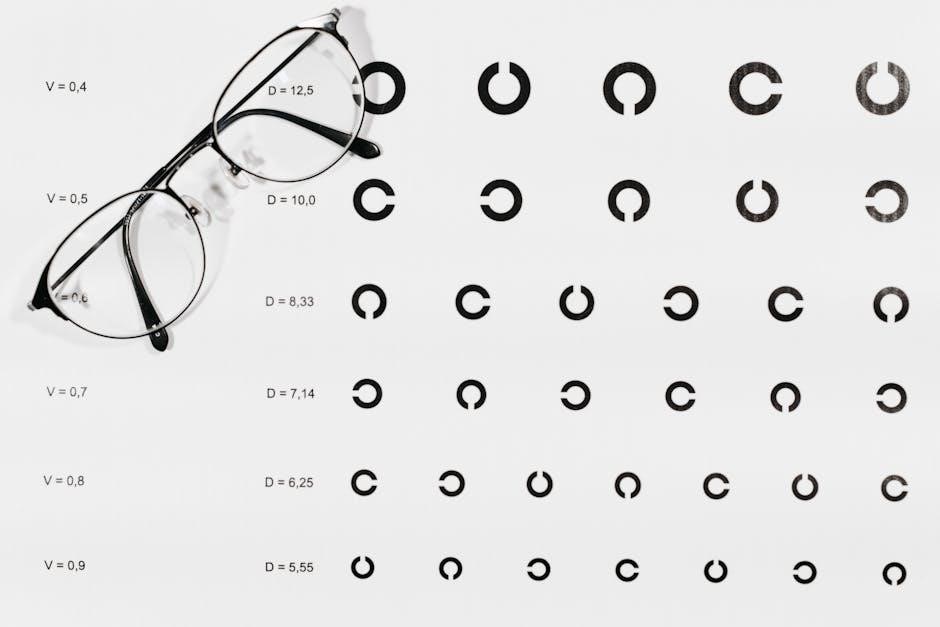
Diamond Buying Guides & Education
Diamond buying guides and education PDFs frequently incorporate 4Cs charts, simplifying complex grading systems for consumers seeking informed purchasing decisions.
Digital Downloadable Diamond Guides
Digital diamond guides, readily available for download, often center around comprehensive 4Cs charts in PDF format. These resources demystify the grading process, empowering buyers with knowledge about cut, color, clarity, and carat.
Etsy UK offers a Diamond Buying Guide Digital Download, showcasing the practical application of these charts. Such guides typically include detailed explanations, visual aids, and comparative tables. They help navigate the nuances of each ‘C’, ensuring a confident and informed purchase. Accessing these PDF resources is a convenient way to learn at your own pace, before visiting a jeweler or making a final decision.
Diamond Education PDF Resources
Numerous diamond education resources are available as PDF downloads, focusing heavily on the 4Cs chart. These guides, like those from Dorah, provide a structured learning path, explaining cut, color, clarity, and carat in detail. They often include sections on diamond anatomy and conflict-free sourcing.
These PDF documents simplify complex grading reports and offer visual representations of inclusion types. They’re invaluable for understanding how each ‘C’ impacts a diamond’s beauty and value. Utilizing these resources empowers buyers to confidently assess diamonds and make informed purchasing decisions, ensuring satisfaction with their investment.
In-Store Diamond Viewing Experience
While 4Cs chart PDF resources offer foundational knowledge, the in-store experience provides crucial practical application. Examining diamonds firsthand allows assessment of cut’s brilliance, color nuances, and clarity under varied lighting. Comparing stones side-by-side clarifies subtle differences often missed in digital images.
Expert guidance from jewelers complements your PDF-acquired understanding, bridging theory and reality. They can demonstrate how carat weight relates to visual size and explain grading reports. This combined approach – self-education via PDFs and expert in-person evaluation – ensures a confident, informed purchase.
Natural vs. Lab-Grown Diamonds
4Cs chart PDF guides apply to both diamond types; however, lab-grown diamonds often present better value for equivalent cut, color, clarity, and carat weight.
Comparing the 4 Cs in Natural and Lab-Grown Diamonds
Utilizing a comprehensive 4Cs chart PDF reveals striking similarities between natural and lab-grown diamonds regarding cut, color, clarity, and carat. However, subtle differences exist. Lab-grown diamonds frequently achieve higher clarity and color grades at comparable price points. This is due to the controlled environment of their creation.
A PDF guide helps visualize these nuances. While natural diamonds boast rarity, lab-grown options offer excellent value without compromising brilliance. Examining a 4Cs chart allows informed comparison, highlighting how each characteristic impacts value in both diamond origins. Ultimately, the choice depends on individual priorities and budget.
Conflict-Free Diamond Sourcing
Ensuring ethical sourcing is paramount when selecting a diamond, and a detailed 4Cs chart PDF doesn’t directly address this, but supports informed choices. Reputable jewelers prioritize the Kimberley Process, guaranteeing diamonds aren’t from conflict zones.
A PDF guide focusing on the 4Cs helps assess value, allowing buyers to allocate budget towards ethically sourced stones. Traceability is key; ask about a diamond’s origin and certification. Utilizing resources alongside the chart empowers consumers to support responsible mining practices and contribute to a conflict-free diamond trade, aligning values with purchase decisions.
Advanced Diamond Characteristics
PDF 4Cs charts often lack details like F/Cl ratio; however, understanding these nuances alongside the basics elevates diamond evaluation expertise.
F/Cl Ratio in Diamonds
Diamond 4Cs charts, typically in PDF format, rarely detail the F/Cl ratio – the ratio of fluorescence to chlorite inclusions. Research indicates studied diamonds exhibit a ratio between 1.001 and 1.82, mirroring kimberlite findings (0.38-1.68).
This differs from mantle estimates. While not commonly featured on basic charts, the F/Cl ratio provides insight into a diamond’s origin and formation conditions, appealing to advanced collectors and gemologists. It’s a subtle characteristic influencing value and authenticity assessments beyond the standard 4Cs.
Diamond Shapes and Their Impact on the 4Cs
Diamond 4Cs charts, often available as PDF downloads, illustrate how shape influences perceived quality. For example, elongated shapes like marquise or pear can appear larger for a given carat weight. Cut grades vary by shape; brilliance assessment differs significantly between round brilliant and fancy shapes;
Color is also affected – some shapes reveal color more readily. Clarity grading can be harder in certain cuts. Charts often include shape-specific considerations, guiding buyers to understand how each shape interacts with the core 4Cs, maximizing beauty and value.
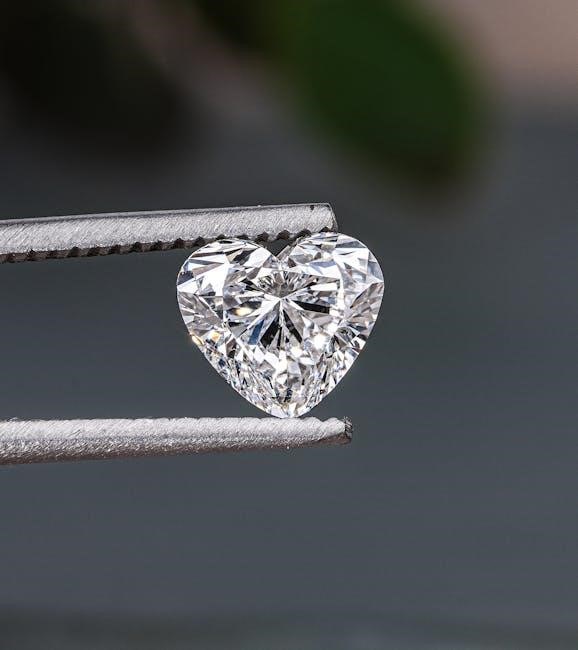
Diamond Care and Maintenance
Diamond 4Cs charts don’t cover care, but maintaining brilliance is key! Regular cleaning preserves the cut’s sparkle, ensuring lasting beauty and value.
Protecting Your Diamond’s Brilliance
While a 4Cs chart PDF guides selection, preserving brilliance requires diligent care. The cut, significantly impacting sparkle, diminishes with grime buildup. Avoid harsh chemicals; warm, soapy water and a soft brush suffice for cleaning. Regularly inspect prongs, ensuring secure setting—a loose diamond compromises brilliance and risks loss.
Storing diamonds separately prevents scratching from other jewelry. Consider a soft pouch or lined jewelry box. Understanding how the 4Cs interact—particularly cut—highlights the importance of maintaining its integrity. Professional cleaning and inspection annually are recommended, safeguarding your investment and ensuring enduring radiance.
Cleaning and Storage Tips
Referencing a 4Cs chart PDF aids understanding a diamond’s value, but proper care maintains its beauty. Gently clean with warm water, mild dish soap, and a soft brush. Avoid abrasive cleaners that can damage settings or dull the stone. Rinse thoroughly and dry with a lint-free cloth.
For storage, wrap each diamond separately in a soft cloth to prevent scratching. Store in a jewelry box or pouch, away from direct sunlight and extreme temperatures. Regular cleaning—every few weeks—prevents buildup that diminishes brilliance, impacting the perceived quality detailed in the 4Cs.
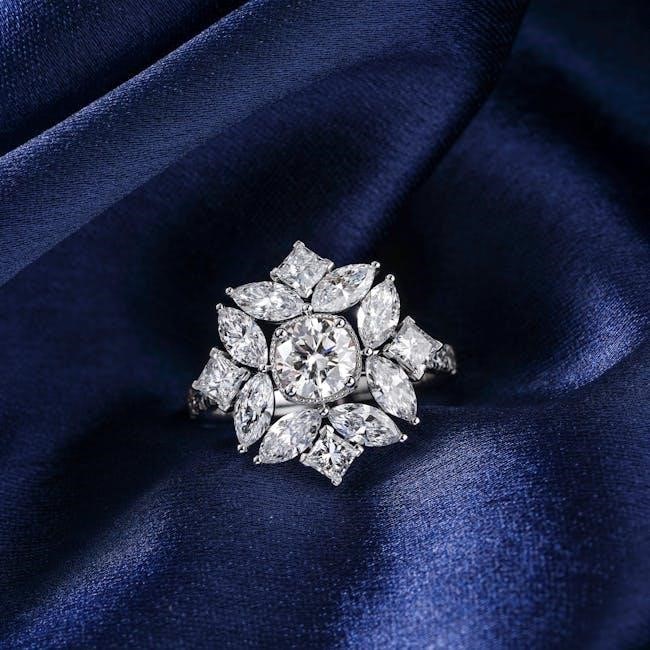
Resources for Further Learning
deBebians’ diamond scale chart and FV Kaminsky’s diamond pin offer valuable insights; explore 4Cs chart PDF resources for comprehensive education.
deBebians Diamond Scale Chart
deBebians provides a readily accessible diamond scale chart, frequently offered as a PDF download, designed to simplify understanding the crucial 4 Cs. This chart visually represents the grading scales for cut, color, clarity, and carat, enabling buyers to quickly assess diamond quality. It’s a fantastic resource for beginners, illustrating the nuances within each category.
The chart details the range of each ‘C’, from flawless clarity to included, and colorless to light. It helps correlate these grades with potential price points, empowering informed purchasing decisions. Utilizing this PDF guide alongside in-person viewing is highly recommended for a complete evaluation.
FV Kaminsky’s Diamond Pin
FV Kaminsky offers a practical diamond gauge tool, often visualized as a “pin” or card, aiding in quick carat estimation of mounted diamonds. While not a comprehensive 4 Cs chart PDF, it’s a valuable companion for assessing diamond size. This portable tool allows jewelers and buyers to approximate carat weight efficiently, especially during initial viewings.
Complementing this, broader 4Cs chart PDFs provide detailed grading information for cut, color, and clarity. Using Kaminsky’s pin alongside a full chart offers a holistic assessment. It’s a useful starting point for understanding a diamond’s physical dimensions before delving into its quality grades.
Related Posts

hanuman chalisa telugu pdf download
Hanuman Chalisa‚ a revered hymn‚ praises Lord Hanuman's strength and…